T'sillan BDG · Est. Local boydidgoodT'sillan BDG Buy a Bottle · $35
Marine Gelcoat Coating · Made by Hand

T'sillan BDG

Webless Summer
Gelcoat Sealant · Built for Spider Country
For boats where spiders are the maintenance problem.

"I made the product I wish I'd had 30 years ago. Takes some work but it works." — Lee

Gelcoat Only Bonds On Contact Aracniphobic-ish Seasons, Not Weeks
§ 00 · Hi, I'm Lee

Hi, I'm Lee.

I've been detailing boats for over thirty years — most recently out here on Lake Chelan. Most of what I know got worked out on other people's hulls — what holds up, what doesn't, what the big-brand products quietly fail at when the conditions get specific.

T'sillan BDG is the wax I wish I'd had for the last thirty years.

— Lee · Local boydidgood

More about me

My career has been defined by thirty years of trade work, industrial innovation, and a commitment to the work of marine restoration. My path didn't start at a desk — it started with the discipline of the U.S. military, a foundation that informed every boat I've ever touched and every crew I've ever led.

Over the last three decades I've worked at the highest levels of this industry. I was a partner in the second-largest boat detailing company in the United States for fifteen years, where I helped develop and scale professional standards across a national and international stage — through a published book and classes taught at our boats or theirs.

My influence on the trade is also embedded in the number-one selling tool boat detailers use every day. I worked directly with SMD and DeWalt as project instigator, technical consultant, and prototype tester to help design the DeWalt DWP849X rotary polisher. From the ergonomics to the speed-control features, that machine carries the fingerprints of years of hands-on feedback. Fourteen of the seventeen ideas I submitted made it into the final product.

These days I figure I should be teaching people how to dance with that machine — not fight with it to get to what I've already learned.

I've always believed in paying it forward through education and development — and now, through an answer to the pleas of boaters who want their boat to look good long after the buffing is done.

Webless Summer · Gelcoat Sealant & Spider Repellant By Lee · Watch on YouTube
§ 01 · The Problem

You know the black spots.

You've watched the white gelcoat under your covered slip go gray and speckled. You've spent weekends scrubbing droppings that wouldn't come off, and noticed the etched shadows they left behind. You've tried the peppermint sprays — they lasted about two weeks.

The damage isn't dirt. Spider droppings carry the same digestive enzymes spiders use to liquefy their prey — and on gelcoat, those enzymes etch. By the time you can see the stain, the gelcoat is already pitted underneath. No amount of scrubbing rebuilds the surface.

Lee goes back to check a treated boat By Lee · Watch on YouTube
§ 02 · What It Is

A coating, not a cure.

T'sillan BDG is a gelcoat-only bonding lotion designed to be massaged into a properly prepped surface — new, or freshly polished and free of oxidation. The oils absorb into the pores; what you buff off is the bonding layer that stays behind.

It will not restore oxidized gelcoat. It will not make a tired hull look new. Prep is the work; this is the protection that follows.

Designed For

  • New gelcoat
  • Freshly polished, oxidation-free gelcoat
  • Any color — light or dark
  • Boats in covered slips and boathouses
  • Freshwater marinas where dock lines are spider highways
  • Anywhere a season of droppings is the maintenance problem

Mask Off & Avoid

  • Rubber, vinyl, canvas, seadecking
  • Black trim & oxidized metals
  • Already-oxidized gelcoat (polish first)
§ 03 · The Science

Two jobs, one bottle.

T'sillan BDG was engineered to do two things at once. For boats where spiders are the actual problem, it's a long-term presence that arachnid nervous systems read as hostile. For boats where the goal is simply keeping the gelcoat protected, it's a bonded coating that saturates the pores and seals the surface — wash-resistant, longer-lasting than any wax.

"Using a harsher chemical might have some negative side effects — not only in your marina, but also in mine — so I went with things that simply shooed the spiders away. If by some miracle they find their way to your neighbor's boat, that's just awesome. Tell them about this stuff." — Lee

How It Works on Spiders

Spiders taste with their feet. The chemoreceptors that do the work sit on the tips of their legs — the tarsi — and every step is a chemical reading of what's underfoot. T'sillan BDG carries a proprietary blend of plant-derived monoterpenes that arachnid nervous systems read as hostile. When the chemoreceptors on a spider's tarsi meet a treated panel, the surface returns the wrong answer, and the spider moves on. Mammals don't have the receptor.

Why It Outlasts a Spray

Peppermint and citrus sprays work on the same family of monoterpenes — but they sit on the surface, and the first hard rain takes them off. The active chemistry here is bonded into a polysiloxane carrier that seats into the gelcoat itself, so a wash-down doesn't lift it off. Same active mechanism. Different durability altogether.

The Structural Layer

After the bonded layer buffs out, what's left covers the smooth surface and sits down inside the pores. From there the oils release slowly over time — they're not trapped, they meter out. A spray sits on the surface and rinses off. This stays put because it's part of the gelcoat now, and the slow release is what makes it last seasons, not weeks.

We didn't invent the chemistry. We just made it stick.

Bonded in the gelcoat

Buffed and set. Safe to touch — pets and people. Still hostile to arachnids.

In the bottle

Concentrated terpene complex. Keep away from pets, eyes, and mucous membranes during application.

On the label

Polysiloxane carriers · proprietary bio-active terpene complex · hydrophobic polymers

§ 04 · The Method

Six movements.

i

Prep the surface

Wash with Dawn, alcohol, or white vinegar & water — or a dedicated surface-prep wipe. Goal: a uniform gloss that throws a clean reflection at any angle. A flat panel should look mirror-ish. (Reflection at 45° is the rank-amateur threshold; aim higher.)

ii

Mask the off-limits

Tape off rubber, vinyl, canvas, seadecking, black trim, and any oxidized metal. Dried-on product is hard to remove from these surfaces.

iii

Shake. Apply slow.

Soft, clean foam applicator on a random orbital or DA polisher — speed set very low. Treat it like lotion, not wax. The orbital pattern fills round pores better than back-and-forth. Spread with the applicator — don't drip product onto the boat and smear it around.

The applicator should be soft enough that if you wiped it near a baby's face, the baby wouldn't care or make any sort of indication that it was abrasive. — Lee

Hot day · dark gelcoat · sun: work small sections
iv

Massage it in

Imagine pushing the product into the pores of a sponge. Work it until the product is barely visible on the surface. Longer working time = better result; the oils need time to absorb.

v

Buff off the residue

Clean microfiber or a fresh foam pad. What you're removing is the bonding layer — once buffed, the chemistry has already begun setting. No cure time required.

If it over-dries: dab fresh product, buff fast. Saliva works in a pinch.
vi

Inspect

You'll notice fewer fingerprints than a traditional wax. The surface should feel set, not slick. If a panel looks uneven, hit it again — there's no penalty for a second pass.

The full application walkthrough By Lee · Watch on YouTube
+ Full application instructions ~1500 words · the complete walkthrough
PDF Download the printable version 4 pages · 8.5×11"

01What this is for — and what it isn't

T'sillan BDG is designed specifically for gelcoat. RV, boat, or even a shower fixture — but only gelcoat. If you're using this on automotive paint or marine paint, contact me through the website or YouTube and I'll suggest a more appropriate product for your application.

Designed For

  • White gelcoat, properly prepped
  • Brand-new gelcoat, no oxidation
  • Freshly compounded / polished gelcoat
  • Surfaces with a spider problem

Not Designed For

  • Repairing or improving oxidized gelcoat
  • Automotive or marine paint
  • Replacing a proper cut-and-polish step

If you've got oxidation, fuzziness, or surface damage, fix that before applying this. The product will still bond and last a long time on dull-but-clean gelcoat, but it isn't designed to correct anything underneath it.

If you're not sure what gelcoat that's ready for T'sillan BDG looks like — or how to compound it to that point — here's a walkthrough: youtu.be/RyAxm7VlWZ0. There are over 400 more correction tutorials on the Local boydidgood channel. — Lee

02Prep the surface

"Properly prepped" is a little arbitrary — everyone has their own standard. In my mind it should look brand new: wet-paint smooth and shiny, with a clean reflection at any angle, like a mirror. A reflection that only shows up at 45° is the rank-amateur threshold; aim higher. Prep matters more than the product.

Once the gelcoat is clean — washed with soap and water to remove any oils left by previous polishing — and looking right, you're ready to start. Almost.

03Mask off

The product tends to dry white. If you're working near darker canvas, pull it back out of the way, or mask off the panels to avoid contact. Tape off black molding, window trim, and any fittings or accessories sitting on the gelcoat. Dried-on product is harder to remove from those surfaces than from the gelcoat itself.

Keep it off wood, concrete, and other very absorbent materials too — anything porous you don't want to risk discoloring.

04Apply — by machine (preferred)

Tools: a soft foam applicator pad, a random orbital or dual-action polisher, and a clean microfiber or fresh foam pad for removal.

Your applicator needs to be soft enough that if you wiped it near a baby's face, the baby wouldn't care or make any sort of indication that it was abrasive. That soft. — Lee

Always spread the product with an applicator — don't drip it straight onto the boat and smear it around. That matters most on darker gelcoat.

  1. Speed: very slow. There's no need to force this. You're massaging the product in like a lotion, not muscling it on like a wax.
  2. Draw a circle of product on the pad — not at the edge, not in the middle. A ring. On a fresh, dry pad, lay down two rings — one toward the middle, one between that and the edge — because a new pad soaks up product for the first few applications. Once it's broken in, you'll use noticeably less.
  3. Shake the bottle well, often. Then shake it again.
  4. Work it in like you're shoving the product into the pores of a sponge. The random orbital pattern makes many small circles — mathematically, more chances to fill more pores than back-and-forth motion. (Plus it makes nice patterns on the boat, which I've always found entertaining.) Here's a clip of what those gelcoat pores actually look like: youtu.be/WfF1fth9b9k.
  5. Stop when the product is just barely visible on the surface. The longer you work it in, the better the bond — the oils need time to absorb into the gelcoat itself.
  6. Buff off the residue with a clean microfiber or fresh foam pad. There's no "baking time." The layer left behind after the oils absorb is the bonding chemistry — it begins setting on contact. (A foam pad on the buffer throws a little dust here — it wipes off, or hose it down with an in-line water filter and skip drying.)
A foam applicator keeps. Drop it in a plastic bag between sessions and it's good for days — which also means it uses less product over time. — Lee

05Apply — by hand (alternative)

No buffer? A folded white terrycloth towel works. Not microfiber for application — microfiber glides too much. The loops of terrycloth act as mild abrasives that help scrub the lotion into the surface as you apply it.

Draw an "X" of product across the rag, spread it out, and work it in. Slower than the machine method, and you won't quite get the same finish, but it works. Terrycloth also absorbs more product than a foam pad does, so you'll go through the bottle faster.

Waste as much as you like — we have more. — Lee

06Section size and conditions

Start small. Hot day, dark-colored gelcoat, or direct sunlight — work smaller sections at a time to avoid the product over-drying before you've buffed it. As you get a feel for your boat's absorption rate and your local conditions, you can grow the working area.

Every boat lived a different life before you got it — even two of the same model age differently — so there's no universal section size. Start where you can stay in control and grow into it.

If the product does dry on you before you've buffed it: apply a small amount of fresh product to your applicator, re-wet the dried area, and buff quickly with a clean microfiber. If that doesn't lift it, a little saliva does the trick.

That's not my weird sense of humor. That actually is a thing that I do. — Lee

07Maintenance

Maintaining the bond is mostly about not letting dirt bake in. Wash regularly with mild, gelcoat-safe soaps — anything that won't strip wax. Soaps that add a film of protection are better still: Salt-a-way as an additive is worth its weight even if you don't play in saltwater, and a few Turtle Wax soaps leave a protective film behind.

Avoid washes that contain carnauba — carnauba waxes can interfere with the bonded surface over time.

You'll notice the surface picks up far fewer fingerprints than a traditional wax leaves. That's the bonding chemistry doing its work — it should feel set, not slick.

08Reapplication

On the spider side, the effect is meaningful for about 3–4 months per coat. The bonded surface itself lasts much longer — I've seen it hold up under proper maintenance for over three years exposed.

You can reapply over an existing application at any time — you won't hurt the product, the boat, or the RV by doing so. A little extra at the helm every five months never hurt anyone. Reapplication uses less product than the first coat.

09A note on the chemistry, and the spiders

The effect on spiders in this product is intentional. I chose chemistry that moves spiders rather than kills them — for moral reasons more than anything. Harsher chemicals could have negative side effects in not only your marina but mine. If by some miracle a spider finds its way to your neighbor's boat, that's just awesome.

Gelcoat as a material is constantly curing — like glass in old cathedrals, it's still considered a semi-solid liquid. The pores on the inside expand as it ages, which is why no amount of insulation from sun and ultraviolet light can keep gelcoat from eventually fading on its own. The struggle is legitimate and real.
§ 05 · Toolkit

What's on the bench.

Correction · the cut-and-polish

Start with the DeWalt. Fit the Quick Connect, mount a wool pad for the cutting passes and a foam pad to follow, then find what your gelcoat actually needs. Work from the most aggressive compound down — Super-Duty on heavy oxidation, Heavy Cut to even things out, Perfect-It EX AC to bring up the gloss. Test a panel before you commit; most boats don't need the heaviest cut.

01
DeWalt DWP849X Polisher
Variable-speed rotary — the correction machine. Cuts and polishes; not used for sealing.
Lee co-designed this tool with DeWalt and SMD. Fourteen of seventeen ideas he submitted made it into production.
DWP849X
02
3M Quick Connect Adapter
Connects the rotary to the 3M pad system.
3M 05752
03
3M Double-Sided Wool Pads
White = compounding · yellow = polishing — paired with the Quick Connect.
3M 05753 / 05754
04
3M Foam Polishing Pad
Foam pad for the finishing compound pass. Original 05737 discontinued — use the current 05723.
3M 05737 → 05723
05
3M Super-Duty Rubbing Compound
Most aggressive — first cut on heavy oxidation.
3M 05954
06
3M Heavy Cut Compound
Mid-grade — evens out the surface.
3M 36102
07
3M Perfect-It EX AC Compound
Final stage — refines the gloss before sealing.
3M 36060
Sealing & finishing · a different animal

Sealing is a different job. A dual-action polisher is a different animal from a rotary — random orbit, lighter touch, low speed — so don't reach for the DeWalt here. (No machine? A folded terrycloth towel applies it by hand.) Mount a soft black polishing pad, then choose the finish: a wax for those who want one, or T'sillan BDG for everyone else.

08
Dual-Action Polisher
Any DA (random-orbit) polisher — run at low speed with a light touch. A rotary can strip the sealant, but a DA lays it down far better. No machine? A folded terrycloth towel does it by hand.
any DA
09
Shurhold Pro Polish Pad
6½" soft black foam, dimpled to run cool. Hook-and-loop, two to a pack.
The pad Lee reaches for to lay T'sillan down and buff it back off — applying and removing both.
Shurhold
10
Meguiar's Flagship Premium Marine Wax
A wax finish, for those who want one — polymer protection and UV defence on a prepped surface.
Lee's go-to wax for years, and still in his rotation when a wax is the right call.
Meguiar's M6332
11
T'sillan BDG
Bonded gelcoat sealant — the upgrade from a wax finish.
Lee's own bonding lotion. Seats into the gelcoat itself rather than coating it on top, and seals for seasons. Spider repellent built in.
tsillanbdg.com
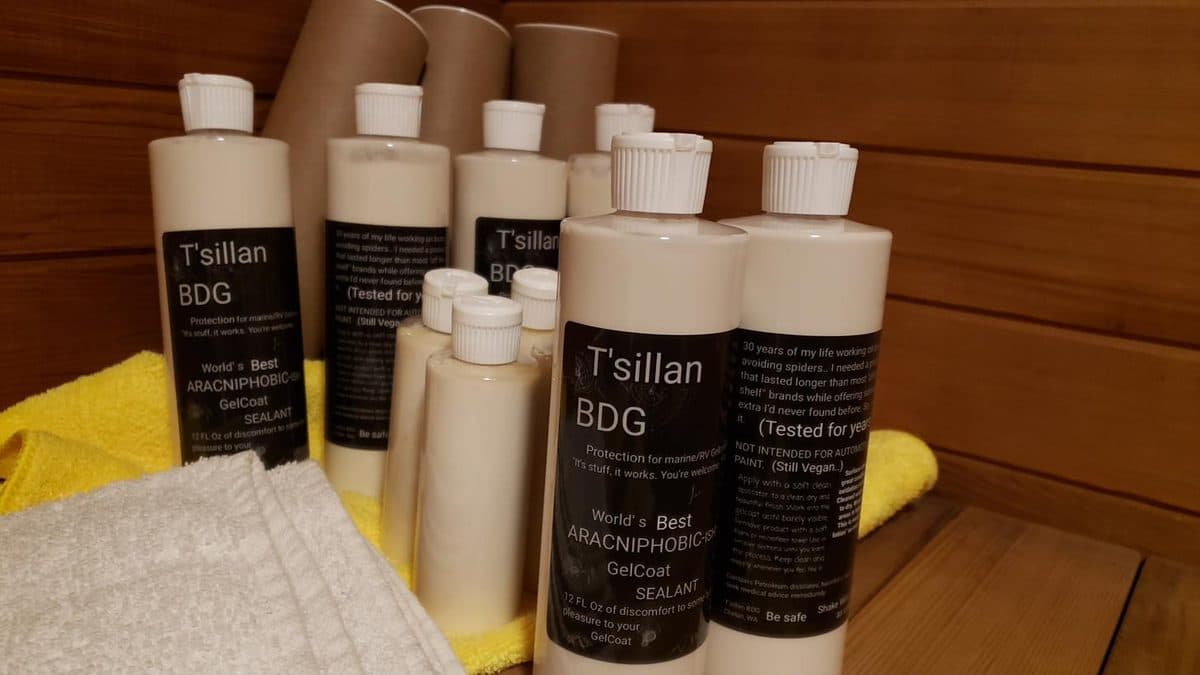
A group of T'sillan BDG bottles on a wooden workshop bench alongside a yellow microfiber towel and a folded gray terrycloth towel.
And, of course, this. 12 fl oz · the whole point of the bench
§ 06 · Maintenance

Keep it clean.

Wash regularly with mild, gelcoat-safe soaps — anything that won't strip wax. Soaps that add a film of protection are even better. Salt-a-way is a worthy additive even in freshwater. A few of the Turtle Wax car soaps leave a protective layer behind too.

The thing that kills any protective coating is dirt baked in by the sun. Don't let it sit. Rinse, wash, and the bond does the rest.

"That's part of the magic of maintaining a boat — fixing things before they are a problem." — Lee

§ 07 · Why It's Worth The Work

Like glass in old cathedrals.

"Gelcoat as a material is constantly curing. Like glass in old cathedrals, it's still considered a semi-solid liquid. As it ages, the pores expand constantly — meaning no matter how well insulated from the sun gelcoat could be, it will always begin to fade out due to its own nature. The struggle is legitimately real. I made this to give you a little bit of leverage in that battle. But it does take work."

— Lee · Local boydidgood
§ 08 · How to Buy

Sold by hand.

T'sillan BDG is sold direct by Local boydidgood via PayPal. Your shipping address is collected at checkout — and there's a field below for the gelcoat color you're treating, in case there's anything worth flagging for your particular boat.

"Waste as much as you like — we have more." — Lee

1
Bottle × 1$35.00 Shipping$14.00 Total$49.00
Address collected at checkout · receipt automatic · ships when mixed & labeled
§ 09 · Questions

What people ask.

Where do I find the full application instructions?

A quick version and a full one. § 04 The Method above is the quick take — six numbered steps to follow at the boat. The "Full application instructions" accordion right under it is the complete walkthrough in Lee's voice, with the detail the six steps leave out. That full version is also a downloadable PDF — same thing, but you can print it or take it offline. Pick whichever fits how you read.

Lee also ships a business card with every bottle (call him if you'd rather talk it through), and there are over 400 videos on his channel demonstrating the underlying detailing work.

Does it kill spiders or just repel them?

Discourages — doesn't kill. The chemistry tells the spider "don't stay," and the spider moves on. Spiders are beneficial in most boating environments (they eat the bugs that bite you), so the goal is to keep them off the surfaces that matter, not eliminate them from your slip.

Will it work on ants and wasps too?

Probably, though I haven't formally tested either. The chemistry that signals "not here" to a spider should read similarly to most small insects. T'sillan BDG was built for the spider problem first — treat any other coverage as a happy side effect.

How is this different from Star Brite Spider Away or peppermint sprays?

The same family of monoterpenes does the active work — that part is shared chemistry. The difference is that sprays sit on the surface and wash off in the first rain (about two weeks of effective protection, per most users). T'sillan BDG bonds into the gelcoat itself and lasts 3–4 months per coat. You're paying for durability, not for a different active.

Will it work in a covered slip or boathouse?

That's specifically what it was built for. Covered slips and boathouses are where spider pressure is highest and where the etching damage shows up worst on white gelcoat.

Is it safe around fish and marine life?

The active chemistry is plant-derived monoterpenes — the same compound class found in peppermint, citrus, and pine oils. Once bonded and buffed, the coating is set on the gelcoat rather than free in the water. The pre-application liquid should be handled like any concentrated essential oil — keep it out of the water during application.

Can my detailer apply this for me?

Yes. The application method is standard for any bonded coating — prep, polish, mask, apply, buff. Any detailer who works with sealants will recognize the workflow. The toolkit above is what Lee uses; equivalent equipment is fine.