Ceramic coating on old gelcoat: does it actually make sense?
Short answer: ceramic bonds to whatever condition your gelcoat is already in — it doesn't fix problems, it locks them in. On a boat with genuinely sound, freshly-restored gelcoat, that's fine. On older, oxidized gelcoat, it's a different calculation.
What ceramic coating actually needs to work
Ceramic coatings need a sound, non-porous surface to bond to correctly. That means fully compounding and polishing older gelcoat back to a like-new condition first — often finished with an isopropyl alcohol wipe-down to prep the surface for bonding — before a ceramic coating goes on. Skip that step, and the coating doesn't fix the underlying oxidation; it seals it in exactly as it was, porous spots and all, which is how you end up with a cloudy or uneven finish under a coating that's supposed to look flawless.
What ceramic needs
A fully restored, non-porous surface — oxidation removed before the coating goes on, not after.
What older gelcoat is
Typically porous and oxidized to some degree — exactly the condition ceramic isn't built to correct.
What happens if you skip prep
The coating locks in whatever's underneath — a cloudy or uneven finish that's now sealed under a hard, expensive layer.
Here's the part that's easy to get wrong: pores aren't something that specifically afflicts old, degraded gelcoat. They're always there, and they never stop growing — it's an ongoing chemical reaction in the curing epoxy itself, coated or not, new boat or old. So a ceramic coating can be a genuinely good choice on a brand-new boat, provided it's maintained rigorously: the right soaps, avoiding anything abrasive, and a topcoat topper applied periodically to keep the coating performing as advertised.
The real issue for an older, DIY-owned hull isn't that ceramic can't bond — prep gets you there, on any boat, any age. It's what happens afterward. If the coating ever needs a scuff repaired or a section re-coated, keeping any warranty intact means going back to a certified installer, and that isn't cheap: a small bottle of a good marine ceramic alone can run up to $300, a full professional application easily runs into the thousands, and even a minor repair burns real shop time. Ceramic is genuinely great for the first month. After that, it's one more thing for the weather to work on — and every touch-up from then on costs installer money, not a DIY afternoon.
A detailer's honest take, from before this was a business decision
That take predates T'sillan BDG by a couple of years — it's not a sales pitch dressed up as an opinion, it's what he was already telling people when he had no product of his own riding on the answer. His broader point, since confirmed directly: ceramic is amazing the first month, and then it's just one more thing for the weather to work on — without ongoing maintenance, every coating eventually fails, including his own former favorites. Most people want a "shine that lasts forever." What actually lasts is upkeep.
What actually makes sense on an older hull
The alternative to ceramic here isn't "nothing" — it's a different kind of bet entirely. Ceramic asks you to keep a certified installer in the loop for life: any repair or re-coat that needs to preserve the warranty has to go through one, and that's real money on top of the original application. A sealant is the opposite bet — inexpensive enough to redo yourself every season, and a scuff or touch-up is wipe-in, wipe-off, no shop visit required.
That's specifically the gap T'sillan BDG is built for — not as a ceramic competitor trying to out-shine or out-last it on ceramic's own terms, but as the answer for an owner who's doing this themselves and isn't looking to keep a certified installer on retainer. In Lee's own words: ceramics are a pain to install and a pain to maintain — amazing the first month, and then it's just one more thing for the weather to work on.
Both a ceramic coating and a sealant like T'sillan need the same thing to start: correct and perfect the gelcoat, strip it of oils and contaminants, then coat the surface to lock in the shine — washed with a pH-neutral soap that won't strip wax or coatings, ideally one that leaves a protective film as it dries. Neither is a shortcut around that work. Where they actually diverge is everything after prep. T'sillan is wipe-on, work-in, wipe-off — no baking time, no waiting, one documented process start to finish, and ongoing maintenance is just a polymer-based spray detailer between washes. Ceramic means working in small sections with a dedicated applicator, and some coatings require waiting hours between coats before wiping down again — with upkeep after that just as deliberate. Same prep, very different afternoon, and a very different every-few-months after that.
Both need this first
A pH-neutral wash to strip oils and contaminants, on a properly corrected surface — neither is a shortcut around that work.
Ceramic's ongoing cost
A small bottle alone can run up to $300; a full professional application easily reaches the thousands — and any repair means a certified installer to keep the warranty.
Sealant's ongoing cost
Costs less than a decent meal. Touch-ups are wipe-in, wipe-off — no installer, no warranty to protect.
What two years actually looks like
Lee ran his own side-by-side comparison on a deck box: Restructure Marine Polish against several professional ceramic coatings running into the thousands of dollars. T'sillan BDG grew out of that same rigorous, real-world approach — years of Lee's own hands-on testing and refinement, working with a chemist to get the formulation right rather than guessing — the same standard already proven out in this two-year test. Two full seasons later, two years, with zero maintenance on any of them in between — nobody touches these boxes at a busy liveaboard dock, ever — the panel showed the sealant held its own against coatings costing many times as much, and it's easier to apply in the first place.
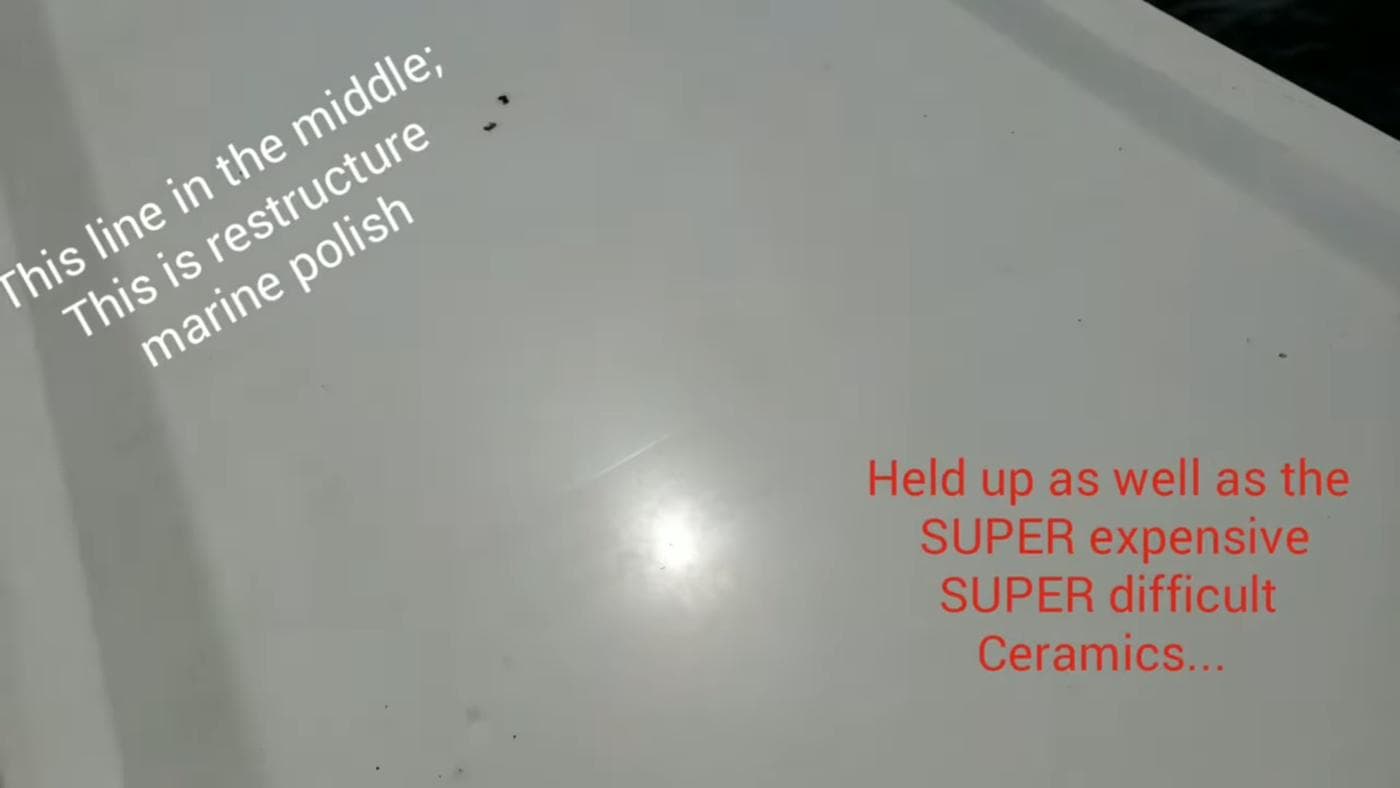
That two-year test isn't the only proof behind this. Lee applies T'sillan on customers' boats in the same small town where he lives and works — not just a demo panel, an actual reputation staked on the results, in person, season after season, not just on camera.
Common questions
- Can you put ceramic coating on old gelcoat?
- You can bond it with proper prep, on a boat of any age — pores in gelcoat never fully go away, coated or not, so that's not really an old-boat-specific problem. The real issue is what happens after: keeping a ceramic coating's warranty intact means any repair or re-coat has to go through a certified installer, which is real, recurring cost. That's a harder trade for an older, DIY-owned boat than for a new one someone's paying to have professionally maintained.
- What's the alternative to ceramic coating on an older boat?
- A maintained sealant, not a coating tied to a certified installer. Both need the same properly corrected surface to start. Ceramic ties any future repair to a certified installer to keep the warranty, which adds up — a sealant costs far less and touch-ups are wipe-in, wipe-off, no installer required.
- Is ceramic harder to install and maintain than a sealant?
- Yes. Prep is identical either way — correct the gelcoat, strip oils and contaminants with a pH-neutral wash. From there they diverge: T'sillan is wipe-on, work-in, wipe-off, no waiting, with ongoing maintenance just a polymer-based spray detailer between washes. Ceramic needs a dedicated applicator, small sections, and some coatings require hours of waiting between coats — with similarly deliberate upkeep after that.
- Wait — isn't T'sillan BDG just a spider repellent?
- No — it's a bonded gelcoat sealant first. Sealing and protecting the surface is the core job; a built-in spider-repellent additive is part of what it does, not the whole product. Both are real, but sealing is the primary function, and the spider repellency is a second benefit built into the same coating.