Do spider droppings actually damage gelcoat?
Short answer: yes — and the damage happens before you can see it. Here's what's actually going on, what it isn't, and what does (and doesn't) protect against it.
Why boats specifically
Marinas and covered slips are close to ideal spider habitat: dock lights draw the insects spiders eat, and the underside of a covered boat offers exactly the dark, sheltered crevices spiders build webs in. It's not that boats attract spiders more than anywhere else outdoors — it's that a boat sitting still under cover, near water and light, checks every box a spider is looking for.
What's actually happening to the gelcoat
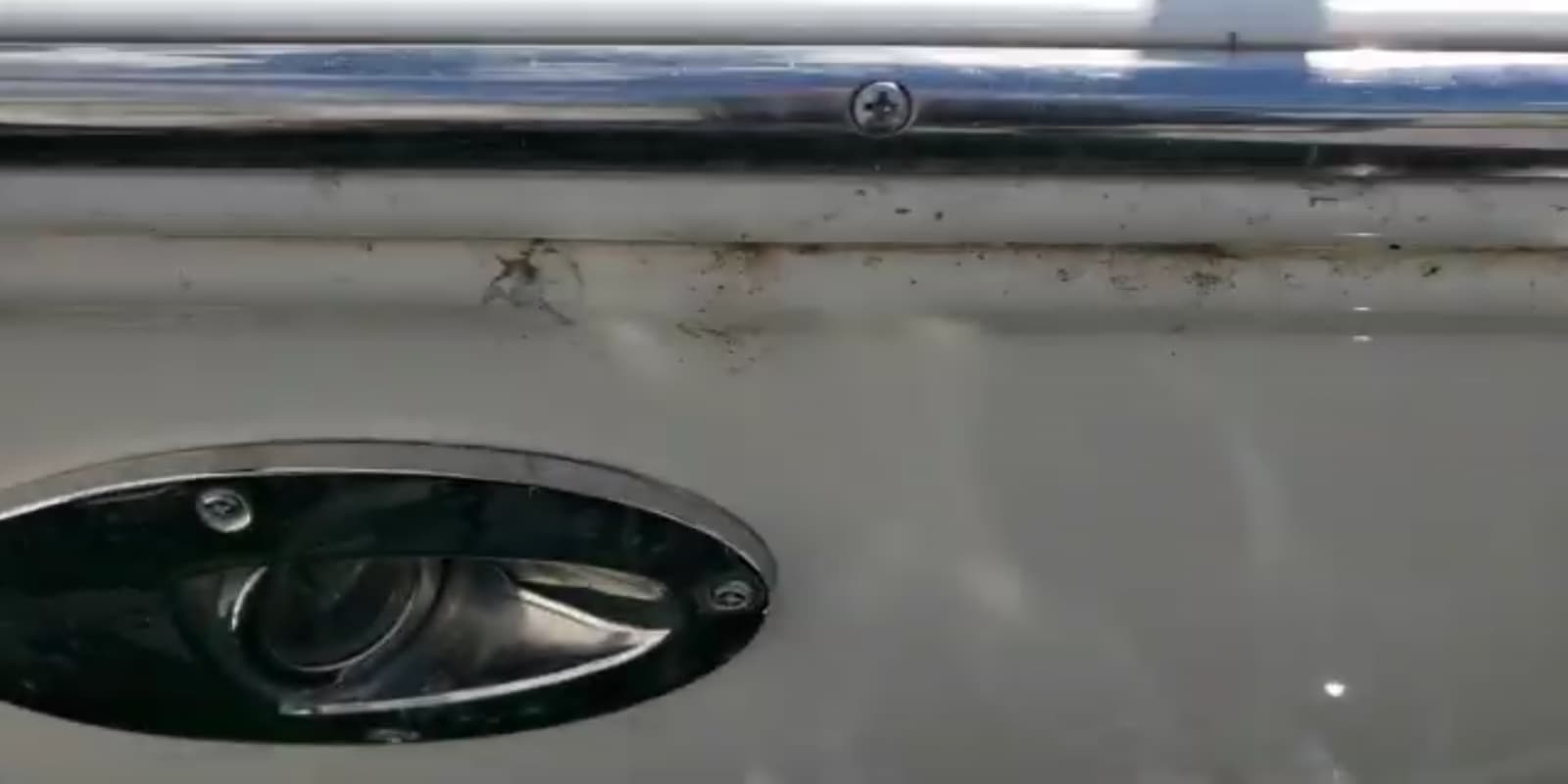
The damage isn't dirt, and scrubbing doesn't reverse it. Spider droppings carry the same digestive enzymes spiders use to break down their prey — and on gelcoat, those enzymes etch the surface. By the time a stain is visible, the gelcoat underneath is already pitted. No amount of cleaning rebuilds a surface that's already been etched; at that point you're looking at compounding, polishing, or in worse cases, recoating.
What it's not
Not surface dirt. Not mold. Not the same thing as "spider cracks" (a structural defect, unrelated).
What it is
Acidic, enzyme-carrying residue that etches gelcoat chemically, beneath what's visible.
Why it's missed
The etching happens before staining is visible — by the time you see it, it's already done.
What deterrent sprays and home remedies actually do
Since the damage comes from spiders being there in the first place, the obvious next step is keeping them off the boat. Peppermint oil, citrus, cedar, dryer sheets, and commercial sprays like Spider Away or Bonide are scent-based: spiders taste with their feet, and the chemoreceptors that do the work sit on the tips of their legs, the tarsi, reading every step as a chemical signal. Peppermint and citrus specifically lean on the same family of monoterpenes T'sillan uses. Ultrasonic repellers work on a completely different mechanism — sound and vibration, not scent — so they're solving the same problem a different way rather than doing the same thing. Either approach is a reasonable first line of defense for keeping spiders away. What none of them touch, scent-based or ultrasonic, is the gelcoat itself: the scent-based ones sit on the surface and the first hard rain takes them off, so they need reapplying every couple of weeks, and none of them do anything for the etching happening underneath the whole time.
Not every boater's problem — but a real one for plenty
Back when Lee was learning the trade, his crew routinely showed up to buff and wax boats covered in webs and spiders. Wash the boat down, watch them land in the water as the rinse ran off — and within a day or two, they'd be back onboard, waiting. Lee's crew used the sprays above the practical way: dock lines, cleats, and decks, days ahead of a scheduled wax job, so the population had thinned by the time they arrived. It worked, mostly — and it meant reapplying every two weeks, 20-plus times a year, for a problem that size. That's a lot of product and a lot of extra labor for a small pest.
The actual idea came from a side conversation. Lee was working with a gelcoat sealant manufacturer at the time — new mixes would ship up, and Lee's crew would test them and send back notes. The question he kept coming back to: could a spider deterrent actually live in suspension, held within the sealant itself, instead of sprayed separately on top? That question is where this actually started.
Years and a cross-state move later — different coastline, different spiders, same problem — Lee kept working the idea with a chemist: starting from a sealant base and adapting it to hold those deterrent oils in suspension, spread them evenly, and give them time to absorb into the gelcoat's pores before the coating cured and locked them in place. The oils themselves are the deterrent — the same plant-derived monoterpenes described above, not something added just for scent. Three-plus years of testing formulas and techniques against that goal led to what's now T'sillan BDG.
He didn't just ship the idea — he went back and checked it. Revisiting a boat he'd treated about a month earlier, one that had already sat through a couple of storms, he confirmed it was still holding up. That verification matters because of the pace involved: at a marina he checked on the same trip, roughly 80% of boats that had arrived within the previous two months were already inundated with spiders — every stanchion, every life-ring, every fire extinguisher box. Whatever protects a boat has to hold up against that speed, not a hypothetical one.
T'sillan BDG: sealing first, repelling as part of the same system
That's what all that testing became: a bonding gelcoat sealant with those same deterrent oils suspended right in the coating instead of sprayed on top — bonded into a polysiloxane carrier that seats into the gelcoat itself. A wash-down doesn't lift it off the way a light rain lifts a spray, which is why the repellency lasts up to about 4 months instead of days, and why it's still sealing the surface the entire time a spray would already be gone. Most boats sitting in a marina for a season are covered by one application; boats in the water year-round, reapply every 5 to 6 months. Two jobs, one coating — the repellency isn't a separate product bolted on, it's the same suspension already sealing the surface.
That's the two-part problem a spray-only approach doesn't solve: it protects the spider-deterrent job for a couple of weeks, and it never protects the surface at all.
Job one
Seals the gelcoat surface against enzyme etching from droppings.
Job two
Built-in spider-repellent additive — deterrent effect included, not a separate step.
Why that matters
One application covers the surface and the deterrent, instead of one product for protection and a different one for spiders.
Common questions
- Is this the same thing as "spider cracks" in gelcoat?
- No — spider cracks are a structural defect (web-pattern surface cracks from flex, impact, or cure issues), unrelated to actual spiders. This page is about biological staining and etching from real spider droppings.
- Do spider repellent sprays protect my gelcoat?
- They reduce how many spiders come back, but the effect fades in days to weeks and needs reapplying — and none of them protect the surface itself or reverse etching that's already happened.
- How is T'sillan BDG different from a spray repellent?
- Same active mechanism, different durability. Both work on the same family of plant-derived monoterpenes that arachnid nervous systems read as hostile. A spray sits on the surface and the first hard rain takes it off. T'sillan's chemistry is bonded into a polysiloxane carrier that seats into the gelcoat itself, so a wash-down doesn't lift it off — that's why it lasts up to about 4 months instead of days.
- Will I still see spiders right after applying T'sillan BDG?
- Possibly, for the first few days. After the first week, any spiders still around are typically newly hatched ones that haven't learned to read their environment yet — it takes a little time for them to process that the boat tastes bad before they balloon away to friendlier harbors. Not a sign it isn't working, just a short adjustment period.
- How often do I need to reapply T'sillan BDG for spider repellency?
- About 3 to 4 months per application, which covers most boats sitting in a marina for a season. If a boat's in the water year-round, reapplying every 5 to 6 months keeps it covered.
- Why do spiders like boats so much?
- Dock lights draw the insects they eat, and a covered slip offers exactly the dark, sheltered crevices spiders look for to build webs.